Sunday, August 24, 2008

3 Tips to Surviving in Bangalore

Tip Number 1: Insist on the meter. When you’re traveling around the city, the easiest mode of transportation is the auto rickshaw. Ricks are everywhere. In most parts of the city, you won’t have to wait more than 30 seconds to find an available driver. They’re especially splendid because they’re small enough to fit through the holes in traffic that most cars can’t manage, which means you’ll get to your destination at least 40 seconds faster. In Bangalore, all rickshaws are metered. The current rate is 7 Rupees (18 cents) per kilometer, but if you don’t insist that they use the meter, they won’t. I learned my lesson the hard way. When I first got to India in June, I ignorantly paid over 10 times what I should have for a ride home one day. I wondered why the driver was so unusually enthusiastic about his job, but when “let’s mock Elliot for how much he paid” became the hottest new craze to hit school since the advent of the iPod, it seemed to make sense.

In the past few weeks, Joey and I have taken to using the bus system. It’s substantially cheaper, and now that Bangalore has discontinued use of the Chinese buses they were testing, it’s just as safe. Our advisor, Jacob, told me that the local government had purchased 100 buses from China as a trial run for a large fleet replacement they were preparing to make. “Too many” of them spontaneously burst into flames during operation, he said, so they decided to go with a different company.

Tip Number 2: Be Flexible. When you go to a restaurant, you might not get what you ordered. When you’re getting ready for school, the water might not work—and if it does, it might be frigid. When you’re in the middle of cooking dinner, watching a movie, or typing a paper, the power might go out. These things happen all the time. There are language barriers, there are problems with the plumbing systems, and the city of Bangalore is straining its power capacity.

Let me tell you about a real inconvenience, though. At my school, there are 3 computer labs. Each lab has the following utilities:

Lab 1: Windows, USB drives, printers. This lab has only two computers and is operated by two college employees. Because it's the only place on campus where students can print things, you have to use the computers as quickly as possible. You are only allowed to print here, you can't use a computer for anything else.
Lab 2: Windows, internet access.
Lab 3: USB drives, internet access, some obscure operating system that is incompatible with everything ever created.

Note that no single lab has the combination of Windows or Mac OS, internet, and printers. One day, I typed an essay at school using Microsoft Word which I needed to print. How did I do it? Can you solve the riddle? I typed my paper in Lab 2 (remember, you can't type in Lab 1), then emailed it to myself. I walked to Lab 3 and downloaded my document from my email onto my USB drive. Then I walked to Lab 1, where I uploaded my document from my USB drive and printed it.

The point is that if you’re not flexible, you will soon be insane.

Tip Number 3: Don’t drink and drive Don’t walk and text message. If you aren’t paying attention while you walk down the sidewalk, you’re gambling with your life. In Bangalore, sidewalks double as overflow lanes for traffic. At any moment, motorcyclists attempting to get around traffic jams may swerve off the road. If you’re in the middle of typing, “I dnt lk indian food, letz eat smwhr else”, you are going to die.

But renegade motorcycles are only part of the fun that awaits you on your journey to the grocery store. Under every sidewalk in Bangalore is a large drainage ditch. Sidewalks are actually nothing more than the 3-inch-thick concrete slabs which cover them. These slabs are commonly cracked, broken into pieces, or missing entirely, so if you aren’t watching where you’re walking, you might find yourself plunging knee-deep into something unpleasant.

One day, on our way to school, Joey and I saw a couple of shopkeepers place a piece of cardboard over an exposed portion of drainage ditch. We turned to each other in horror with the obvious acknowledgment that this little maneuver was going to hurt someone. And suddenly, it hit me. Suddenly, I realized exactly what was going on. Suddenly, I realized exactly how boring it must be selling bananas and lemons all day. Suddenly, I realized that these gents were merely doing the best they could with what they had. They had created an underground gambling ring built around a system in which patrons can place bets as to how much time will pass between pedestrians falling into their booby trap. These men needed entertainment, and in that moment--in that sudden moment--I finally realized the extent of this truth. I also discovered how incredibly creative Indian shopkeepers are. Give them a lemon, and they’ll make an underground gambling ring.

Wednesday, August 20, 2008

Beggars

I felt a little uneasy writing this article, because I didn’t want anyone to interpret what I say the wrong way. So as you read, please remember that this is not supposed to be “Elliot’s Guide to Dealing with India’s Poor People: the Observations of a Disconnected Rich American”. This is simply an account of my personal experience, which includes concepts/activities/behaviors that have been explained to me by the people I’ve met here. That being said, let me tell you a little bit about institution of begging in India.

Beggars are everywhere—outside of churches, schools, malls, and stores. You can’t walk more than a kilometer without being approached at least once—especially if you’re white. It’s not so much the fact your skin is lighter as it is an obvious indication that you are a foreigner. While you’ll often be asked to pay more for rickshaw rides and approached more often by beggars and hagglers, there are actually lots of “advantages” to being white (this sounds like a ridiculous thing to say, but please just bear with me). At many restaurants and hotels we’ve visited, the staff seemed to make a considerable effort to ensure that we had everything we needed. Even my teachers and friends at school consistently ask me “how everything is going”, if my living conditions are adequate, and in general, go out of their way to make me feel comfortable. But beggars know you’re a foreigner too, and the general assumption is that white people are rich.

Deciding whether or not to give money can be difficult. My friend Zeeshan told me that begging has developed into sort of a “business” in India (as it has in many countries). There are entire families of beggars who work under “pimps” (for lack of a better word). The pimps sometimes employ hundreds of beggars and control several neighborhoods. But the word “employ” can be misleading; essentially, the beggars turn over everything they make during the day in exchange for food and shelter, and the pimps buy themselves a pair of Ray Bans. It’s sick; and what’s even more sick is that there have been reported incidents of self-mutilation by the beggars and even mutilation of their own children in an attempt to increase their collections. Zeeshan also told me that there are very successful professional beggars. He explained that by successful, he meant that there are families that make so much money begging, they own a house, a car, and even a big screen TV. “It’s very hard, man, very hard. Some people really do need money; you just can’t tell who they are.”

He’s right; it’s very hard. It’s nearly impossible to really know. When beggars ask for money, they almost always say that they’re hungry. In this instance, an obvious alternative to giving money is simply to give them food. If they’re legitimate, they’re very grateful.

I’ve given cash to someone only once. She was a little girl (about 7 years old) who had developed a sort of street performance. She had a large metal ring which she used to do contortionist body movements through. After a series of gymnastics, she concluded with a string of back handsprings down the sidewalk and ended with a back flip. I gave her some money, because I was pretty impressed.

Sunday, July 27, 2008

Bombings

In case you haven't heard, there have been a series of terrorist attacks in India during the last week.

In Bangalore, 9 bombs went off throughout the city within minutes of each other during the busy Friday lunch rush. The devices were set on timers and despite their low-intensity, 2 people were killed and 12 others were injured. Besides a jammed cellphone network, I was more or less unaffected by the blasts, although two of them did go off in my neighborhood. On Saturday, a live bomb was diffused in a mall that Joey and I walk through (or next to) everyday, which is a little unsettling.

In Ahmedbad, a city about 929 miles from Bangalore, 17 more bombs were detonated on Saturday. This attack was far worse with 46 people accounted dead so far and 161 people injured. A little-known group called the "Indian Mujahideen" has claimed responsibility for this second attack. They also claimed to have carried out the attack in the western city of Jaipur in May where 63 people were killed.

I was a little nervous while all this was taking place, and I half-expected every vehicle that passed me to explode. People have returned to life as usual though, so I guess I might as well too. My friend, Aj Mal, from Afghanistan has told me, "Small bombs, small bombs, no problem", so I'm doing my best to take solice in that.


Sunday, July 13, 2008

Old Storm Cloud

After some thought, I decided that this update should stay off the Internet until I've secured my grades for this semester. I'm sending it to everyone on the mailing list, though. If you're not on the list and you want a copy, let me know.

Tuesday, July 8, 2008

Adventures at the Arabian Sea

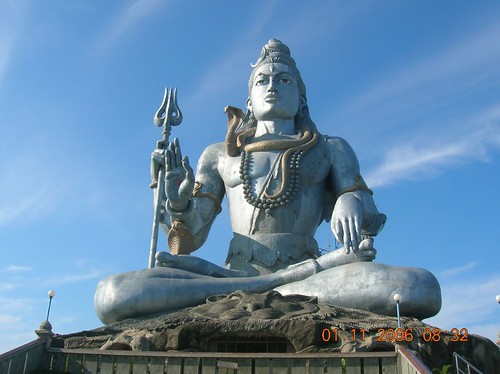
We're traveling fiends. Last week we made a visit to the west coast village of Murudeshwara. It's 282 miles from Bangalore, and takes about 8 hours by bus. "Murudeshwara" is another name for the Hindu god Shiva, and the town is famous for its 123 foot tall statue of him. It's pretty intimidating.

The highlight of the trip was definitely the Arabian Sea. It's monsoon season, so during our swims and walks along the beach, the weather would abruptly shift from warm and sunny to violently windy with torrential rain. Torrential, I'm telling you--it felt like being pelted with icicles. In a moments time, the weather was gorgeous again, though, so we didn't mind too much. The beach was littered with interesting things. Litter, for one, but also fisherman, whale bones, enormous puffer fish, and dead dolphins. It was awesome.

The trip home was quite an adventure in itself. There were a shortage of seats, so our group had to divide between two sleeper coaches. The buses are specially designed to distribute the impact of each and every hole in the road across the two upper cots in the back of the bus (where Joey and I were sleeping). You could have told me the bus was rolling down a hill, and I would have believed you.

Things were worse on the other bus, though. One girl was awakened in the night to the sound of someone... well, he was pooping. She wasn't certain at first, but when the stench of diarrhea began to burn her nostrils, it was pretty well settled. She then saw him wrap his treat up in some newspaper and throw it out the window. When he got down from his cot a while later, he had large brown stains running down the back of his pants.

Simply hilarious.

Sunday, July 6, 2008

The Cat of Nine Tails

I received my first dose of chastisement during school yesterday (that’s right, on Saturday—we have school on Saturday). It was the end of my Health Economics class, and everyone was packing up their things and talking amongst themselves. I was putting things into my backpack and whistling to myself, when I hear my professor start hissing at me. I look over at him and he motions for me to come over to him. “Why are you whistling?” he asks me angrily. I’m stunned, of course, but my background in national television interviewing has taught me to think on my feet. “Uh, I’m very sorry, Sir. It will never happen again.” I stammer. “Whistling is not allowed!” he confirms, “Now return to your seat!”

I passed him in the hall later that day, and was again summoned with a barrage of sharp hisses. When I turned around, he gave a couple snaps of his finger to indicate the pressing nature of his beckon. I let out a long sigh secretly in my head and marched over to him. The conversation went as follows:

Professor: What do you have to say for yourself?

Me: I’m very sorry, Sir (assuming he was referring to that morning’s incident).

Professor: What you have done in the class is a serious offense! Whistling will not be tolerated!

Me: Yes, Sir. It will never happen again.

Professor: Did you think this would be tolerated?

Me: Well, Sir, actually I was not aware of that rule, but I know now, Sir, and it will never happen again.

Professor: You must be aware in the classroom!

Me: Yes, Sir.

At this point, he grunted loudly for good measure and walked away. When I told my Indian friends, they laughed at me, but confirmed that whistling doesn’t violate some cultural law of India. I’m assuming he just hates children.

While I certainly plan on watching my step in the future, the whole ordeal was absolutely hilarious and definitely worth the beating.

In the Midst of the Action

We had school off a couple days ago and took the opportunity to visit the city of Mysore (about 91 miles Southwest of Bangalore). Among other things, we visited the gorgeous Mysore Palace—previously the official residence of the former royal family of Mysore. The palace is quite unique in that it can be illuminated at night in a variety of ways: with spot lights, as seen here, or with over 10,000 actual bulbs lining the walls, as seen here. Other palace novelties include courtyard tours on a beast of your choice. For $2.50, I rode the elephant.

Our fun was far from over, however. After a decision by the government of Kashmir to award a section of protected forest land to a group of Hindu pilgrims, a week of violent protests by Muslim activists ensued throughout the state. The decision was rescinded, which then caused the Hindu-nationalist Bharatiya Janata Party (BJP) to call for a nationwide strike to put pressure on the state government. The violence was much more contained down here in southern India, but we still saw evidence of the protests. We were in the middle of enjoying a delicious lunch on the way to Mysore when suddenly this crowd of BJP members swarmed the restaurant and forced the owner to shut down. Fortunately our adviser from the college was traveling with us and knew what was happening. The second he saw them coming he said, "Children! Finish eating right now, we go!"

When we got into Mysore, our van had to make a U turn because government buses were being attacked by drunk protesters throwing rocks on the road ahead. We took another street. When we finally reached the hotel, we arrived to find that it had already been closed. The van drove around to the back though, and we entered through the back door of an attached restaurant. I never really felt like I was in danger, but we were instructed to only use the stairs because the elevator could be seen from the street. It was pretty exciting, to say the least.

Anyway, I'm safe and sound, so don't worry.